 English
 Русский
 Bahasa Indonesia
 Bahasa Malay
 ไทย
ไทย Español
 Deutsch
 Български
 Français
 Tiếng Việt
 中文
中文 বাংলা
বাংলা हिन्दी
 Čeština
 Українська
 Română



Today, the Australian dollar is attracting new buyers in response to aggressive statements made by Reserve Bank of Australia (RBA) Governor Michele Bullock.
The Reserve Bank of Australia decided to leave the Official Cash Rate (OCR) unchanged at 3.6%. In the accompanying statement, the regulator noted that the Board will closely monitor incoming data and change assessments of risks and outlook when making policy decisions.
During the press conference, RBA Governor Michele Bullock emphasized that inflation and labor market indicators will play a key role in decisions made at the February meeting. She added that further rate cuts are unlikely to be necessary and that the Board discussed possible measures that could be taken in the event that interest rates need to be raised.
Over the past two weeks, markets have reassessed the likelihood that the RBA will continue a tight policy stance, as inflationary pressures remain elevated. As a result, inflation remains above the Bank's target range of 2–3%, calling into question the possibility of significant monetary easing.
Bullock also stated that if inflation proves persistent, it will affect the central bank's future policy decisions. Some analysts believe that as domestic conditions stabilize and inflation shows no signs of slowing, the RBA may halt its easing cycle in 2026 and even consider tightening credit conditions.
On the U.S. dollar side, last week the U.S. Department of Commerce reported that the annual Consumer Price Index (CPI) for September rose 2.8%, in line with market expectations. The core CPI also increased 2.8% from August. Together with signs of labor market cooling, this supports the dovish stance of the Federal Reserve.
According to the CME Group's FedWatch tool, traders are pricing in a 25-basis-point rate cut by the U.S. central bank following the conclusion of its two-day meeting on Wednesday. Such a scenario would limit the dollar's recovery from its December lows, last seen in late October, and support the AUD/USD pair.
For better trading opportunities, attention should be focused on the weekly ADP employment change report and the JOLTS job openings data. After that, the focus will shift to the FOMC decision on Wednesday and the Australian monthly employment report to be released on Thursday.
From a technical standpoint, the oscillators on the daily chart remain positive, though it is worth noting that the Relative Strength Index is approaching overbought territory. Nevertheless, buying above 0.6650 or above Monday's multi-month high will create conditions for further gains and movement toward the yearly high.
On the other hand, weakness in the pair below the round 0.6600 level may be viewed as a buying opportunity within the 0.6560–0.6550 level, below which lies the 100-day SMA. A drop below this moving average will accelerate the decline toward the psychological level of 0.6500. Failure to stay above this level shifts the probability in favor of the bears.
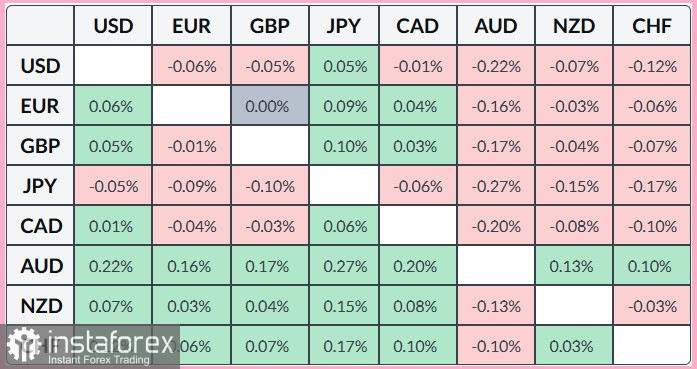
The table below shows the percentage change of the Australian dollar against major currencies today. The Australian dollar has shown the greatest strength against the Japanese yen.