 English
 Русский
 Bahasa Indonesia
 Bahasa Malay
 ไทย
ไทย Español
 Deutsch
 Български
 Français
 Tiếng Việt
 中文
中文 বাংলা
বাংলা हिन्दी
 Čeština
 Українська
 Română


Trade Analysis and Trading Tips for the Japanese Yen
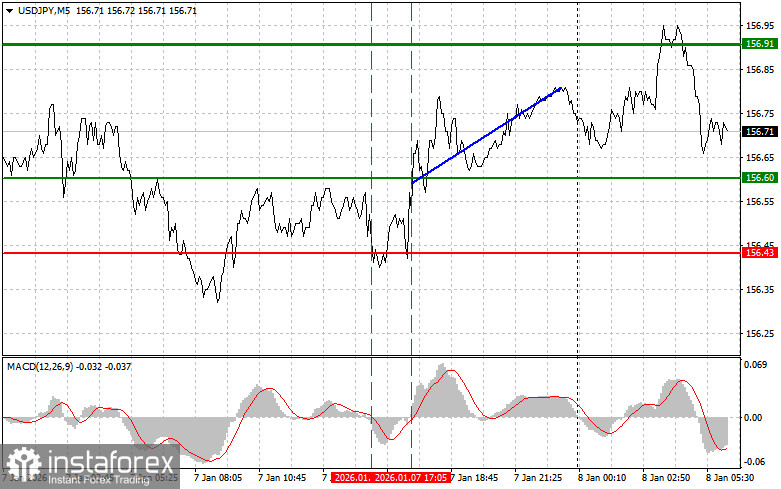
The test of the 156.60 price level coincided with the moment when the MACD indicator was just beginning to move upward from the zero line, which confirmed a correct entry point for buying the U.S. dollar. As a result, the pair rose by 20 points.
Yesterday's ADP report on U.S. private-sector employment for December exceeded November's figures, allowing the dollar to strengthen against the Japanese yen. Next, the market's focus will shift to the release of nonfarm payrolls data, which will be published this Friday.
As for today's Japanese statistics, a report on the consumer confidence index is expected in the near term. This indicator reflects Japanese households' sentiment regarding the current economic situation and future expectations, and it plays a key role in forecasting consumer spending—the most important component of the country's GDP. Traders and analysts closely monitor the consumer confidence index, as it can serve as a leading indicator of economic changes and influence the Bank of Japan's monetary policy decisions. Low consumer confidence readings may signal pessimism among the population, which in turn could lead to reduced spending and slower economic growth. In addition, it is important to consider that consumer confidence in Japan is influenced by various factors, including inflation levels, labor market conditions, geopolitical risks, and even natural disasters.
As for the intraday strategy, I will rely primarily on the implementation of Scenarios No. 1 and No. 2.
Buy Scenarios
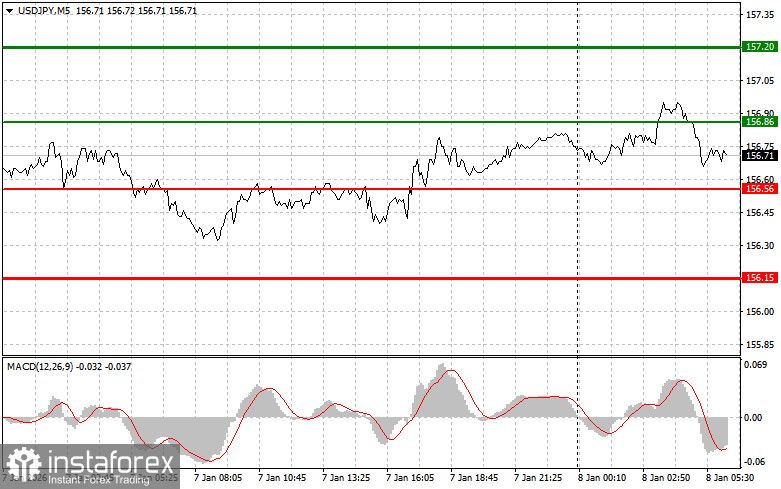
Scenario No. 1: Today, I plan to buy USD/JPY if the price reaches the entry area around 156.86 (thin green line on the chart), with a target of growth toward the 157.20 level (thicker green line on the chart). Around 157.20, I plan to exit long positions and open short positions in the opposite direction, aiming for a 30–35 point move from that level. It is best to return to buying the pair during corrections and significant pullbacks in USD/JPY. Important! Before buying, make sure that the MACD indicator is above the zero line and is just beginning to rise from it.
Scenario No. 2: I also plan to buy USD/JPY today if there are two consecutive tests of the 156.56 price level while the MACD indicator is in the oversold zone. This would limit the pair's downward potential and lead to an upward market reversal. A rise toward the opposite levels of 156.86 and 157.20 can be expected.
Sell Scenarios
Scenario No. 1: I plan to sell USD/JPY today only after the 156.56 level is broken (red line on the chart), which would lead to a rapid decline in the pair. The key target for sellers will be the 156.15 level, where I plan to exit short positions and immediately open long positions in the opposite direction, aiming for a 20–25 point move from that level. It is preferable to sell as high as possible.Important! Before selling, make sure that the MACD indicator is below the zero line and is just beginning to decline from it.
Scenario No. 2: I also plan to sell USD/JPY today if there are two consecutive tests of the 156.86 price level while the MACD indicator is in the overbought zone. This would limit the pair's upward potential and lead to a downward market reversal. A decline toward the opposite levels of 156.56 and 156.15 can be expected.
What Is Shown on the Chart
- Thin green line – entry price at which the trading instrument can be bought.
- Thick green line – projected price level where Take Profit orders can be placed or profits can be manually secured, as further growth above this level is unlikely.
- Thin red line – entry price at which the trading instrument can be sold.
- Thick red line – projected price level where Take Profit orders can be placed or profits can be manually secured, as further decline below this level is unlikely.
- MACD indicator – when entering the market, it is important to rely on overbought and oversold zones.
Important. Beginner forex traders should be extremely cautious when making market entry decisions. Ahead of major fundamental reports, it is best to stay out of the market to avoid being caught in sharp price fluctuations. If you decide to trade during news releases, always place stop-loss orders to minimize losses. Without stop orders, you can very quickly lose your entire deposit, especially if you do not use proper money management and trade large volumes.
And remember that successful trading requires a clear trading plan, such as the one presented above. Spontaneous trading decisions based solely on the current market situation are an inherently losing strategy for an intraday trader.