 English
 Русский
 Bahasa Indonesia
 Bahasa Malay
 ไทย
ไทย Español
 Deutsch
 Български
 Français
 Tiếng Việt
 中文
中文 বাংলা
বাংলা हिन्दी
 Čeština
 Українська
 Română


Global markets are in turmoil. On Monday, stock markets opened with massive sell-offs, with the Shanghai Composite and Nikkei 225 losing over 3.5% from Friday's close, and European indices dropping somewhat less, but still starting the session down over 1.5%. Concurrently, bond yields surged sharply, which corresponds to a drop in bond prices and an overall exit of investors into cash. The uncertainty is too high to calculate any long-term strategies.
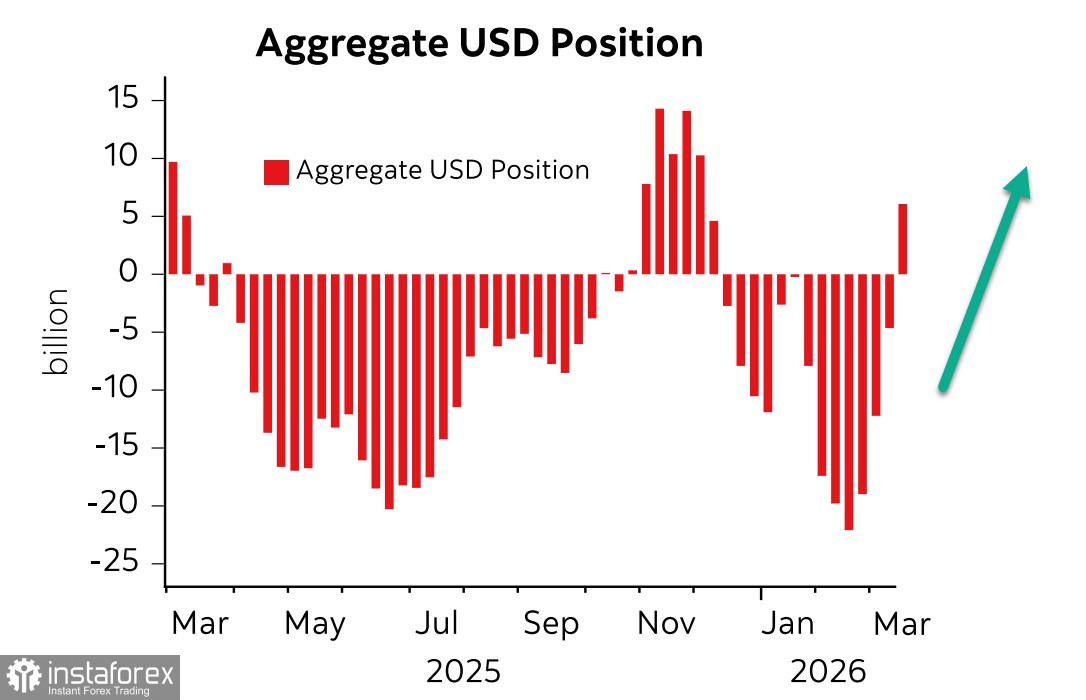
The CFTC report indicated that the cumulative positioning of the US dollar against major currencies became bullish, with a weekly change of +$11 billion, primarily driven by a total sell-off of the euro, which saw a weekly change of -$12.3 billion. In the current environment, the dollar appears to be the safest asset, but it's not that simple.
A new wave of panic began after President Trump issued an ultimatum to Tehran, demanding that the Strait of Hormuz be opened within 48 hours, or the US would strike power plants. In response, Iran stated that it would attack all US-related infrastructure in the region, including not only military bases but also energy and financial institutions. The ultimatum expires on Monday evening, and it is impossible to predict how events will unfold; one can only guess or not guess one of the possible scenarios.
Oil prices approached early March highs again amid escalating tensions. However, just minutes ago, markets reversed sharply, with stock indices rising and oil prices dropping below $100. This sudden turnaround was once again catalyzed by Trump, who announced that he had postponed the strikes for 5 days as the US and Iran entered negotiations. Events are changing rapidly, and until the situation stabilizes, long-term forecasts will need to wait.
There are virtually no economic news releases that could provide any basis for predicting the dollar's exchange rate. Futures for Fed rates offer no information, as the market now expects rates to remain unchanged for all of 2026. This is a more bullish outlook than before, generally favorable for the dollar, but it should be noted that this change in sentiment occurred amid concerns about rising inflation, which could be driven primarily by higher energy prices. If US-Iran negotiations are successful, an inflationary explosion may not occur, potentially changing forecasts for the Fed rate again.
Since the market focuses primarily on political rather than economic news, we can conclude that the dollar remains the most sought-after asset and that a sell-off is unlikely. If news of the start of US-Iran negotiations is confirmed, the dollar is likely to weaken. However, if Trump changes his mind again, everything will remain the same.
No economic news is expected to alter the dollar's trajectory this week.