 English
 Русский
 Bahasa Indonesia
 Bahasa Malay
 ไทย
ไทย Español
 Deutsch
 Български
 Français
 Tiếng Việt
 中文
中文 বাংলা
বাংলা हिन्दी
 Čeština
 Українська
 Română


The EUR/USD pair has indeed reversed in favor of the U.S. dollar and resumed its downward movement. Donald Trump achieved his goal by making highly contradictory statements regarding Iran and the conflict in the Middle East. For an entire week, the U.S. leader made statements that contradicted both the situation in the Middle East and Iran's official position. As a result, traders had to decide whom they trusted more. Surprisingly, more trust was placed in official Tehran. Therefore, the dollar has been rising for five consecutive days, sellers are active again, and traders do not believe in a quick resolution of the Middle East conflict. Overall, there is little point in analyzing each statement by the U.S. president, as they do not align with reality or, at the very least, are not confirmed. Negotiations with Tehran may indeed be taking place, but no information on this exists apart from Trump's statements.
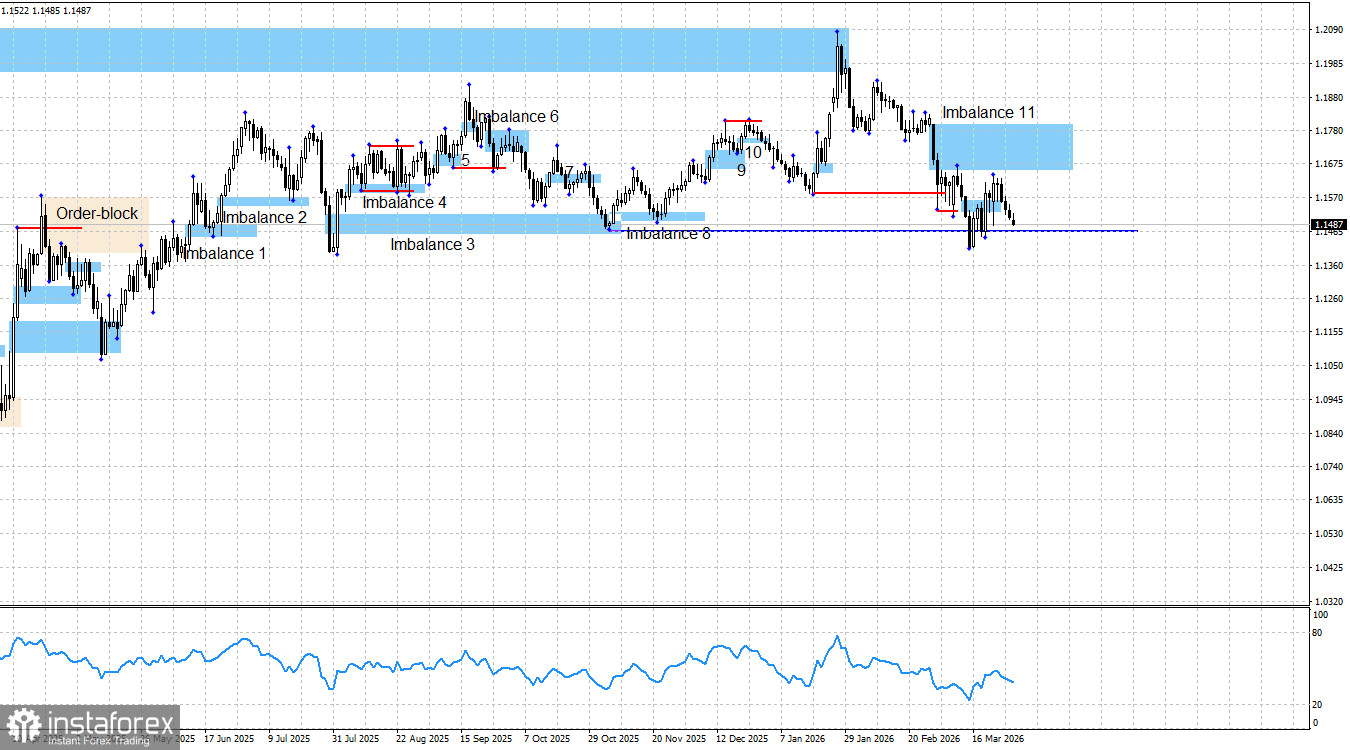
The entire rise of the U.S. currency over the past 4–5 weeks has been driven by geopolitics. That is why I have repeatedly said that I do not believe in the end of the bullish trend, despite the break of key trend-forming lows. At present, imbalance 12 can be considered invalidated, but at the same time, no reaction has been seen from imbalance 11. Therefore, no trading signals have formed recently. The price movement of the past two months could turn into a bearish trend if geopolitics continues to support the dollar.
Further strengthening of the U.S. dollar is possible if geopolitics continues to strongly support sellers. As I have already mentioned, this would require the situation in the Middle East not just to remain tense, but to deteriorate further. How much worse can it get? Oil would need to continue rising toward $150–200 per barrel (which it is already doing), more countries would need to become involved in the conflict (Yemen has already carried out strikes against U.S. allies), and developed economies would need to suffer significantly from high oil and gas prices (this condition has already been met). The conflict itself would also need to last for many months (which appears to be the current trajectory). Previously, I said I did not see the prerequisites for such a scenario, but there has been no positive news from the Middle East.
There are currently no new patterns for opening positions. Even during the current decline of the euro, new imbalances are unlikely to form, as the movement is relatively slow. Thus, the only viable pattern remains imbalance 11, which has not been triggered for a second time.
The chart still signals bullish dominance. The bullish trend remains in place; however, buyers are in a difficult position due to the sharply changing information backdrop. To open new buy positions, new bullish patterns are needed or at least a liquidity sweep of the last two bearish swings. A liquidity sweep has occurred, but it is not a tradable pattern and cannot be used as a basis for opening trades.
The news background on Monday was essentially absent. Neither Europe nor the United States released any notable data. Donald Trump continues to insist on negotiations with Iran and has even postponed strikes on Iranian energy infrastructure for a second time, now until April 6. However, these assurances do little to prevent further gains in the dollar and oil prices.
There are still many reasons for buyers to act, and even the outbreak of war in the Middle East has not reduced them. Structurally and globally, Trump's policy, which led to a significant decline in the dollar last year, has not changed. In the near term, the U.S. currency may strengthen due to investors moving away from risk, but this factor is unlikely to support it indefinitely. There are no other strong drivers supporting the dollar. I still do not believe in a sustained bearish trend. The dollar has received temporary support, but it is uncertain how long this will last.
Economic Calendar for the U.S. and the Eurozone:
- Germany – Retail Sales Change (06:00 UTC).
- Germany – Unemployment Rate (07:55 UTC).
- Eurozone – Consumer Price Index (09:00 UTC).
- U.S. – JOLTS Job Openings Change (14:00 UTC).
On March 31, the economic calendar includes four entries, of which only Eurozone inflation is of real interest. The impact of the news background on market sentiment on Tuesday is expected to be limited.
EUR/USD Forecast and Trading Advice:
In my view, the pair remains in the process of forming a bullish trend. The information backdrop shifted sharply about four weeks ago, but the trend itself cannot yet be considered fully reversed or completed. Therefore, traders need new patterns and signals in the near term to form short-term forecasts and open positions.
In the near future, sellers may receive a signal at imbalance 11, but the price is currently moving in the opposite direction. Buyers, in turn, must rely on the formation of new bullish patterns and further signals for buying.