 English
 Русский
 Bahasa Indonesia
 Bahasa Malay
 ไทย
ไทย Español
 Deutsch
 Български
 Français
 Tiếng Việt
 中文
中文 বাংলা
বাংলা हिन्दी
 Čeština
 Українська
 Română


The EUR/USD pair showed a slight increase on Monday after rebounding from the 50.0% Fibonacci level at 1.1745, moving toward the 61.8% corrective level at 1.1824. Today, a rebound from the 1.1824 level or a consolidation below the 1.1745 level will favor the US dollar and a resumption of the decline toward the 38.2% retracement level at 1.1666.
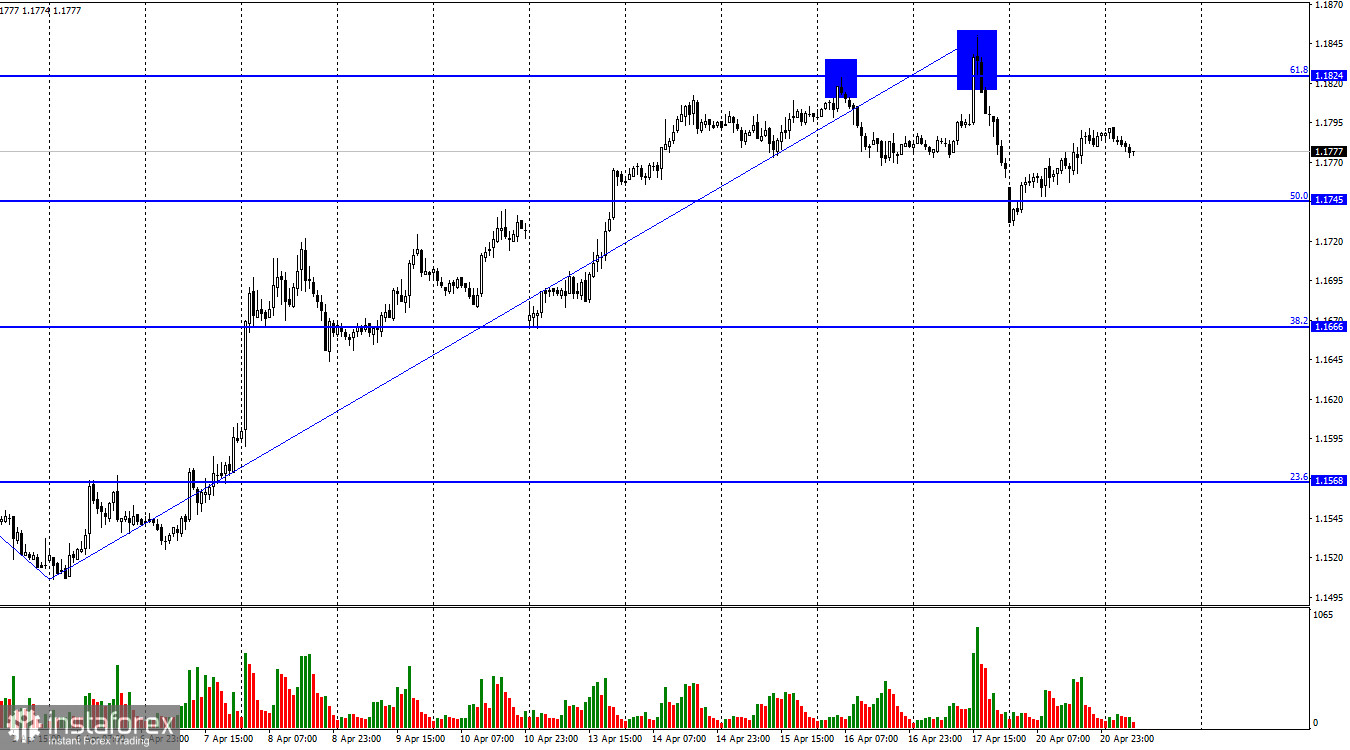
The wave situation on the hourly chart currently raises no concerns. The last completed upward wave broke through six previous peaks, while the last completed downward wave failed to break the previous low. A two-week truce between Iran and the United States supported the bulls, allowing them to form a strong upward wave. Thus, the trend is currently "bullish." In the near future, the geopolitical background may worsen again, which would give strength and confidence to the bears. However, breaking the bullish trend would require two downward waves or a break below the April 6 low.
There were two important events on Monday. First, Tehran announced the cancellation of the second round of negotiations with the United States due to the American side's refusal to lift the blockade of Iranian ports and the Strait of Hormuz. Later in the evening, European Central Bank President Christine Lagarde delivered a speech. It's worth stepping slightly away from the geopolitical factor, especially since we will likely receive much more information on this topic during the week. On Monday evening, Lagarde stated that the regulator has begun to face difficulties in determining monetary policy parameters. "At this time, we cannot be confident in any particular monetary policy path due to uncertainty regarding the scale and duration of the military conflict in the Middle East," the ECB head said. Lagarde also noted that the information backdrop is constantly changing: at times the sides are negotiating, at other times they are ready to resume hostilities; the Strait of Hormuz opens and closes intermittently. As a result, the ECB cannot form clear forecasts regarding the conflict's impact on the eurozone economy. According to Lagarde, more time and information are needed to assess the consequences of the war in the Middle East. Therefore, the ECB may adopt a neutral decision at its April meeting.
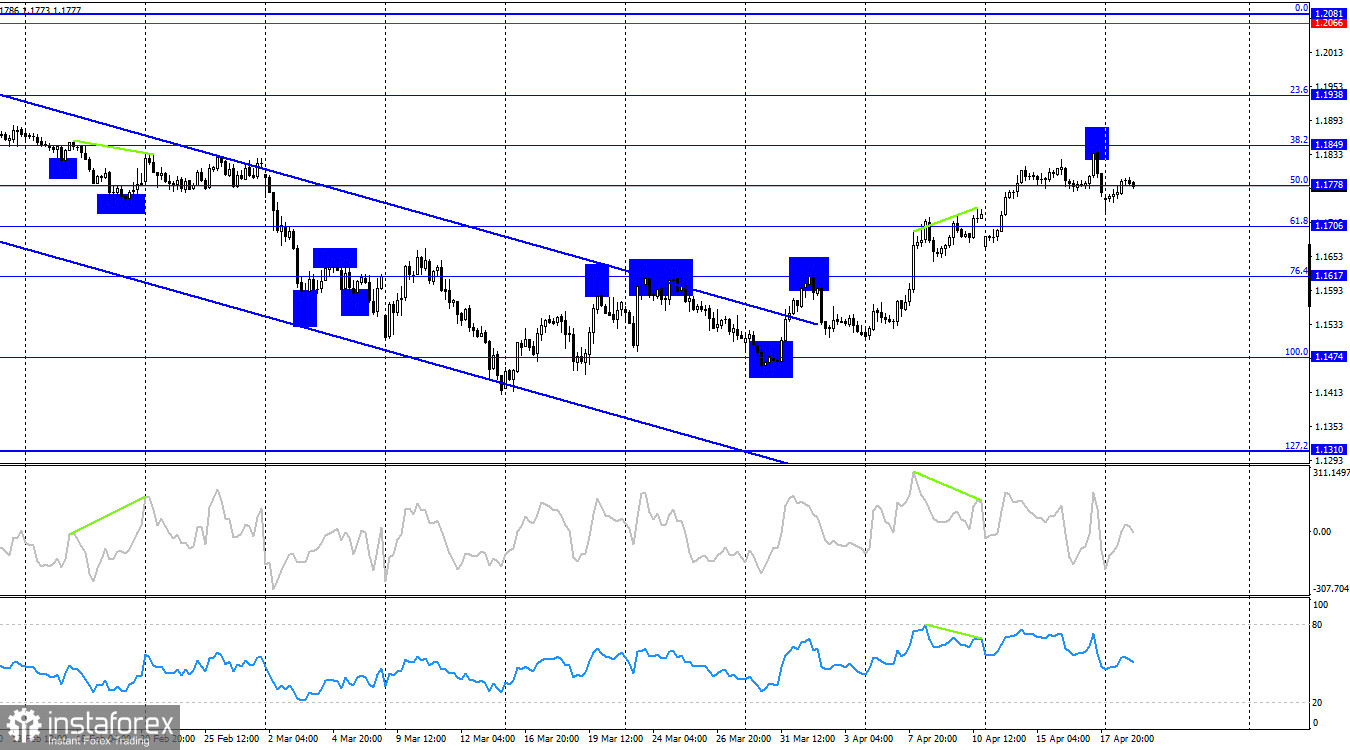
On the 4-hour chart, the pair rebounded from the 38.2% retracement level at 1.1849, reversed in favor of the US currency, and consolidated below the 50.0% Fibonacci level at 1.1778. Thus, the decline may continue toward the next retracement level of 61.8% at 1.1706. A consolidation above 1.1778 would allow bulls to launch a new attack targeting 1.1849. No emerging divergences are currently observed on any indicators.
Commitments of Traders (COT) report:
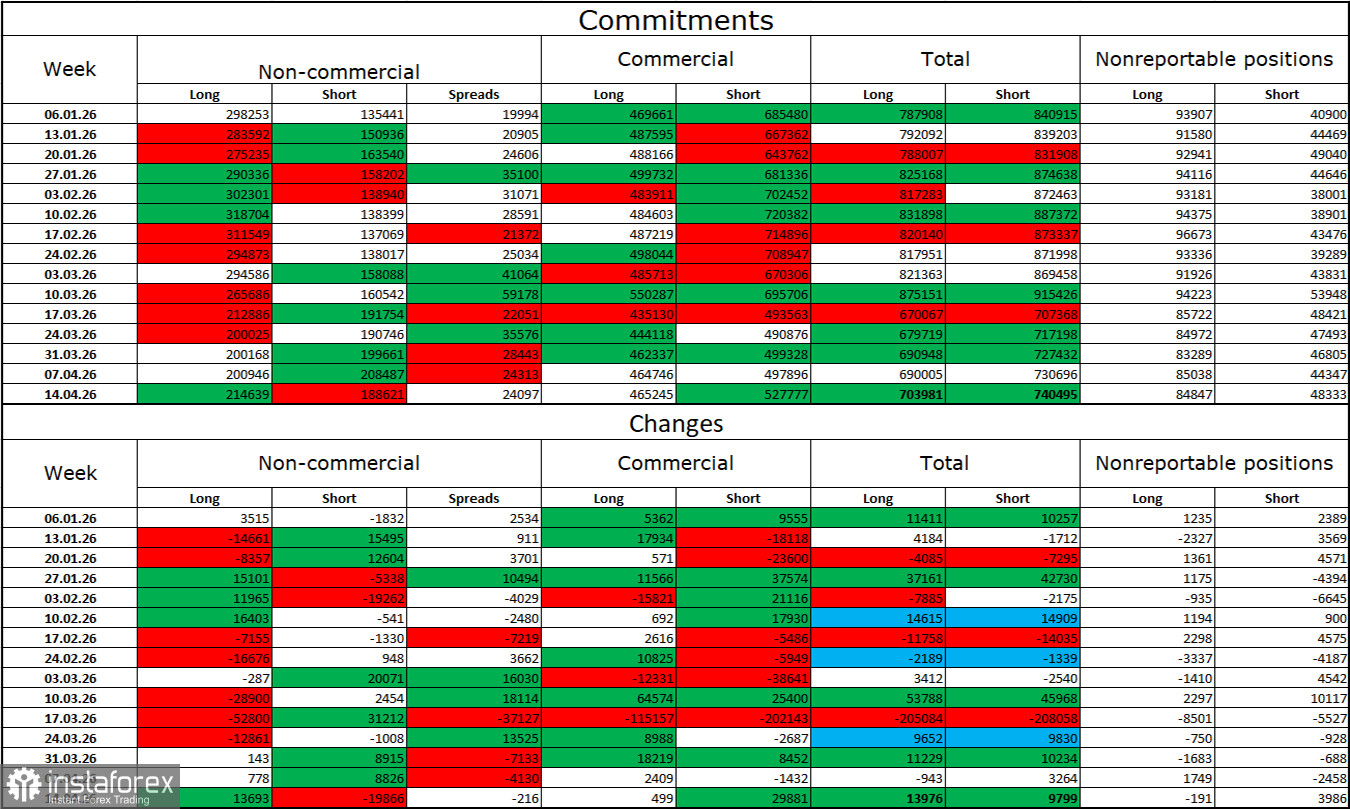
During the latest reporting week, professional traders opened 13,693 long positions and closed 19,866 short positions. Over seven weeks, the bulls' total advantage has evaporated. The total number of long positions held by speculators now stands at 214,000, while short positions total 188,000. Two months ago, bulls held more than a twofold advantage among non-commercial traders.
Overall, in the long term, large players continue to show strong interest in the euro. Naturally, various global events—of which there has been no shortage in recent years—affect investor sentiment. At present, the market's attention remains focused on the Middle East, where the war has only been paused, not ended. Thus, in the near term, the euro and dollar exchange rates will depend not on the monetary policies of the Federal Reserve or the ECB, nor on economic data, but on the war in Iran. The dollar may still benefit from this situation.
Economic calendar for the US and the Eurozone:
- Eurozone – ZEW Economic Sentiment Index (09:00 UTC).
- Germany – ZEW Economic Sentiment Index (09:00 UTC).
- US – ADP nonfarm employment change (12:15 UTC).
- US – Retail sales change (12:30 UTC).
On April 21, the economic calendar contains four entries, none of which strongly attract attention. The influence of the news backdrop on market sentiment on Tuesday is expected to be limited.
EUR/USD forecast and trading advice:
Selling the pair was possible after a rebound from 1.1824 on the hourly chart with a target of 1.1745 (target reached). New selling opportunities arise upon a close below 1.1745 with a target of 1.1666. Buying positions are recommended upon a rebound from 1.1745 with a target of 1.1824.
Fibonacci levels are drawn from 1.2082–1.1410 on the hourly chart and from 1.1474–1.2082 on the 4-hour chart.