 English
 Русский
 Bahasa Indonesia
 Bahasa Malay
 ไทย
ไทย Español
 Deutsch
 Български
 Français
 Tiếng Việt
 中文
中文 বাংলা
বাংলা हिन्दी
 Čeština
 Українська
 Română


Analysis of Macroeconomic Reports:
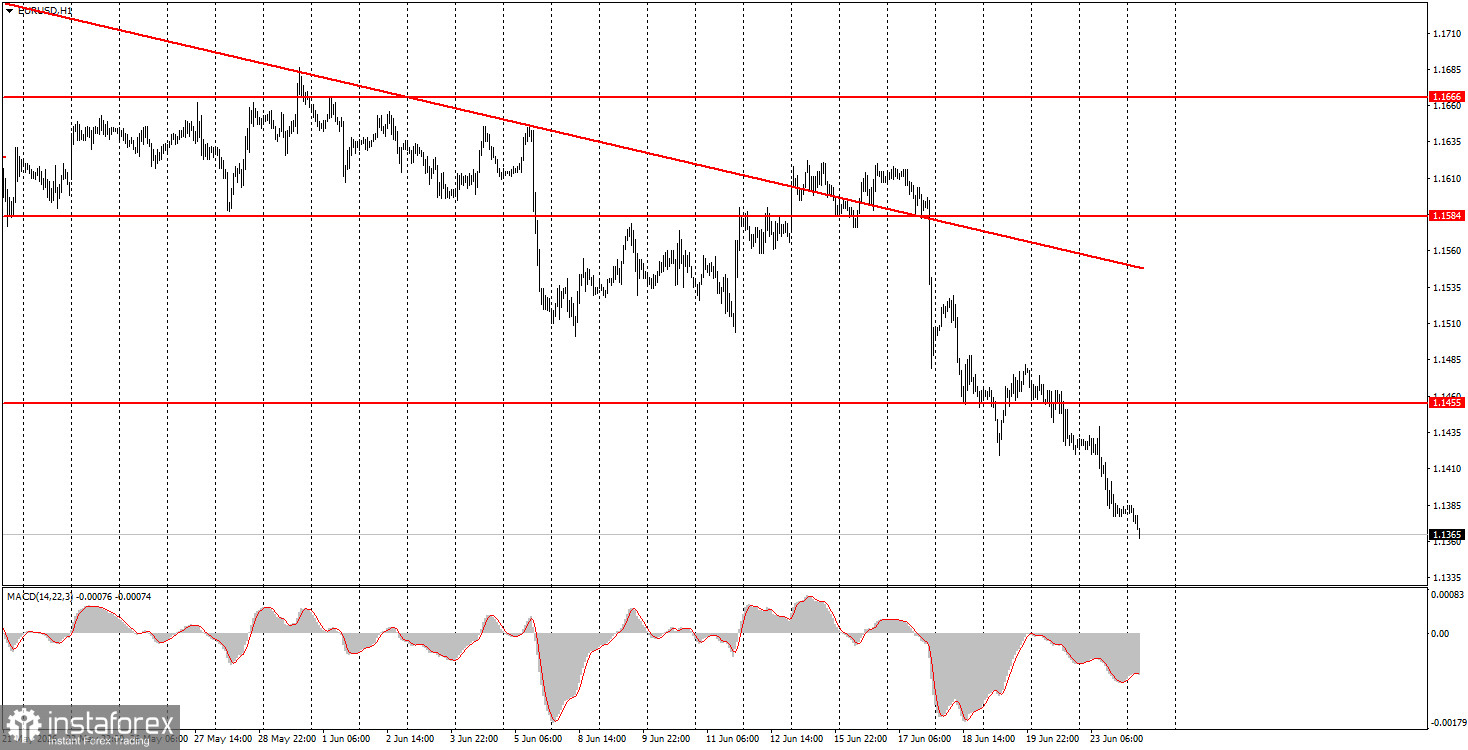
Very few macroeconomic reports are scheduled for Wednesday. In Germany, the Ifo business climate report will be published today. In the U.S., data on new home sales will be released. Both reports are considered secondary, so we do not expect any market reaction to these data. It is worth noting that the dollar's growth has been ongoing for an entire week, so it is doubtful that any reasons or foundations are required for such a movement. We do not believe the decline in both currency pairs is ongoing due to the Federal Reserve's stance on inflation and monetary policy. The market is currently ignoring all factors that are not in favor of the dollar. This looks very much like market-maker manipulation.
Analysis of Fundamental Events:
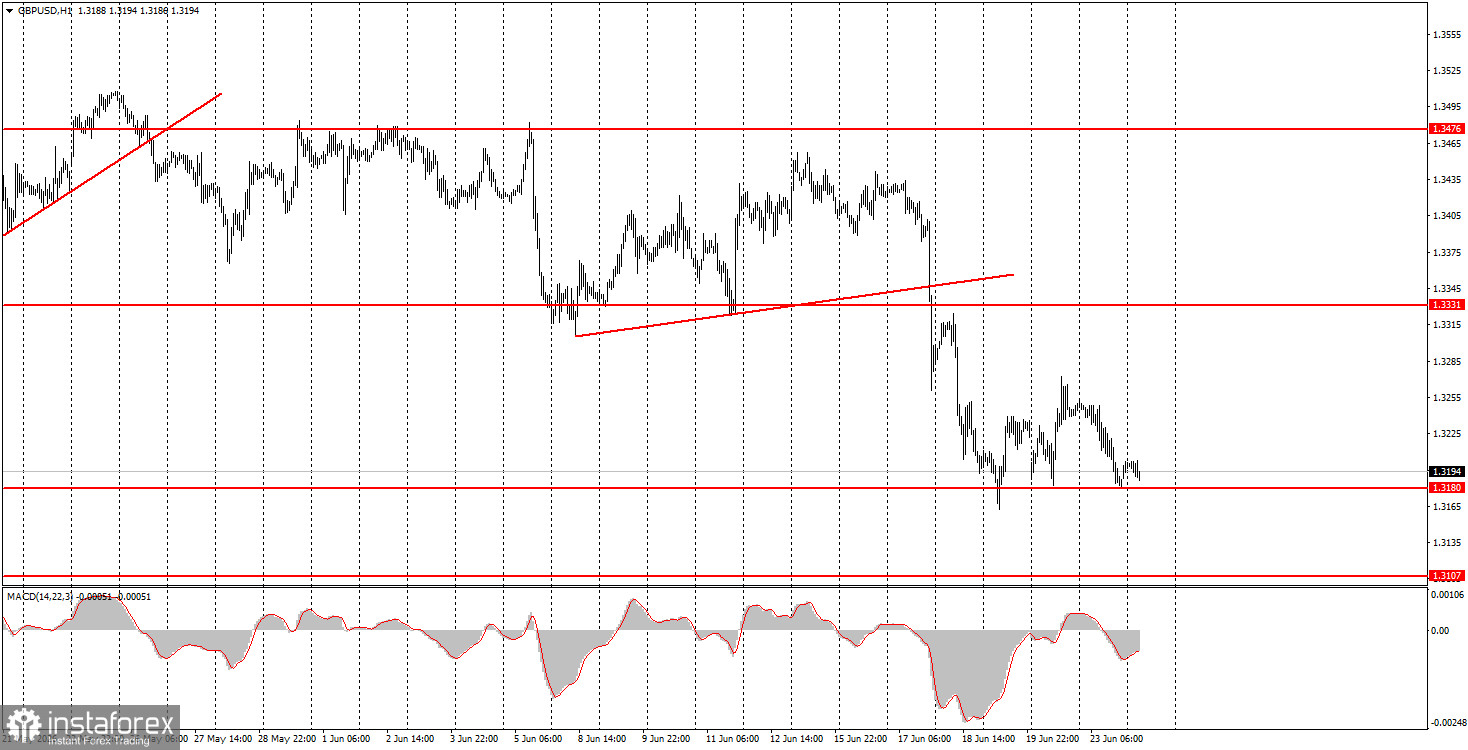
Among the fundamental events on Wednesday, we can highlight speeches from European Central Bank representatives Piero Cipollone and Patrick Montagner, Bank of England's Swati Dhingra and Huw Pill, as well as Bundesbank head Joachim Nagel. However, let us remind you that two weeks ago, the ECB held a meeting during which it raised rates for the first time in three years, and both the BoE and the Fed held meetings last week without making any important decisions. Thus, given the short amount of time that has passed, it is unlikely that the tone of the central bank representatives has changed enough for us to hear anything new in their speeches.
The geopolitical backdrop remains stably "conditionally positive." Iran and the U.S. signed an agreement remotely, but too many important issues remain unresolved. In particular, the "nuclear issue" which is not even mentioned in the current text of the agreement. This is precisely the problem that sparked the war and could lead to its resurgence at any moment. Negotiations over the nuclear deal began over the weekend, and initial progress was achieved. The U.S. lifted sanctions on Iran, unblocked access to its assets, and agreed on a plan for Iran's recovery. For now, Iran has opened the Strait of Hormuz.
General Conclusions:
During the third trading day of the week, both currency pairs may begin to correct after a strong decline, but if the decline continues, we would not be surprised. The euro can be traded from the area of 1.1354-1.1363, while the British pound can be traded from the area of 1.3175-1.3180. The market has absolutely undeservedly bought the U.S. dollar in recent days, which may be a trap set by market makers for bears.
Basic Rules of the Trading System:
- The strength of a signal is evaluated based on the time it takes to form (bounce or breakout). The less time required, the stronger the signal.
- If two or more trades were opened at a particular level based on false signals, all subsequent signals from that level should be ignored.
- In a flat market, any pair may generate many false signals or none at all. Technical levels may be overlooked.
- On the hourly timeframe, trading signals from the MACD indicator should be executed only when volatility is good, and a trend is confirmed by a trend line or channel.
- If two levels are too close together (5 to 20 pips), they should be considered a support or resistance area.
- After moving 15 pips in the correct direction, a Stop Loss should be set at breakeven.
What's on the Charts:
Price levels (areas) of support and resistance are targets when opening long or short positions or sources of signals.
Red lines indicate channels or trend lines that display the current trend and indicate the preferred direction for trading.
The MACD indicator (14,22,3) – histogram and signal line – is a supplementary indicator that can also be used as a source of signals.
Important speeches and reports (contained in the news calendar) can significantly impact the movement of the currency pair. Therefore, during their release, trading should be conducted with maximum caution, or one should exit the market to avoid sharp reversals against preceding movements.
Beginners trading in the forex market should remember that not every trade can be profitable. Developing a clear strategy and practicing money management are key to long-term success in trading.