 English
 Русский
 Bahasa Indonesia
 Bahasa Malay
 ไทย
ไทย Español
 Deutsch
 Български
 Français
 Tiếng Việt
 中文
中文 বাংলা
বাংলা हिन्दी
 Čeština
 Українська
 Română


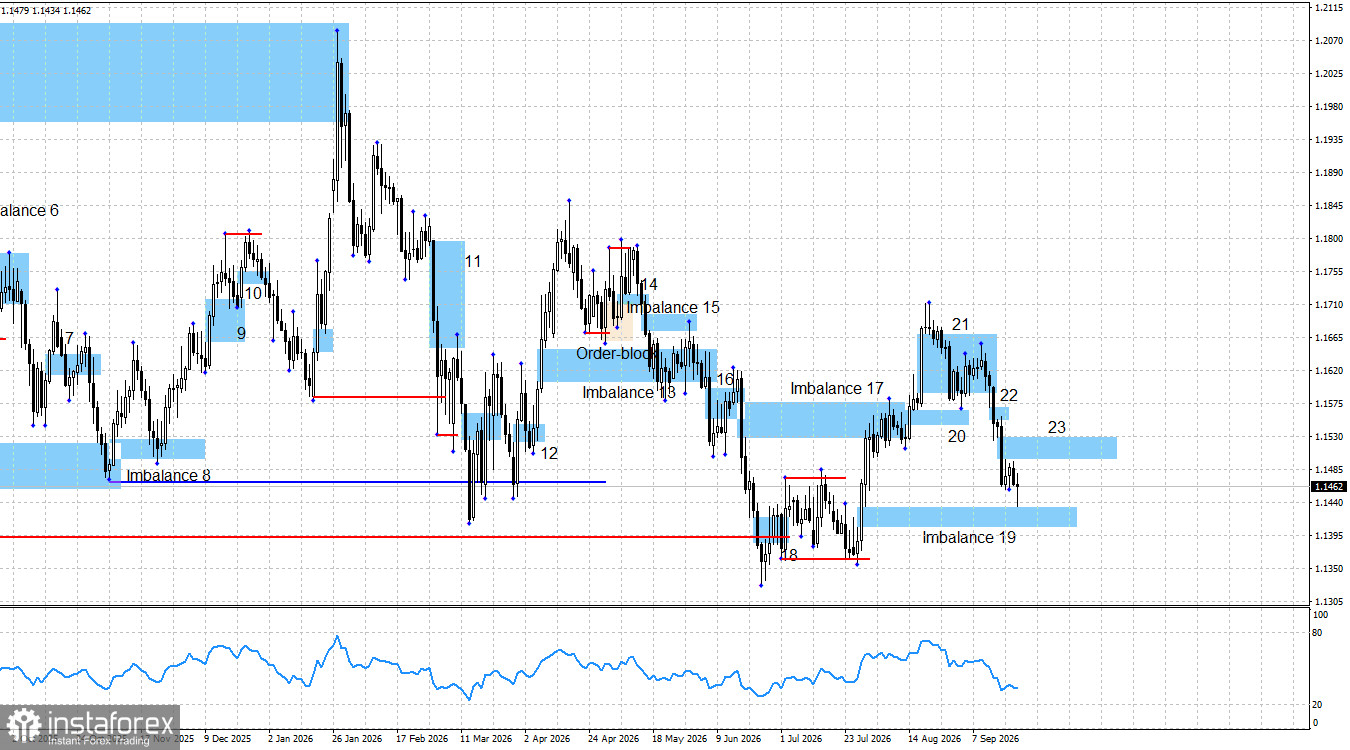
The EUR/USD pair ended last week with an overall loss of 200 points. The new week began with another decline. I would note that the European currency's period of weakness began the week before last as the market prepared for the FOMC key interest rate hike. During this move, the euro fell almost to imbalance 19, which can currently be considered the last line of support for the euro and the bulls. If this imbalance is invalidated, the European currency will not simply continue declining but could also fall below the psychological level of $1.10. At the same time, bearish imbalance 23 was formed, and its very existence makes the bears' prospects considerably more favorable. Now, if the bulls want to launch an advance of their own, they need to break this pattern. Doing so will not be particularly easy under the current circumstances. Nevertheless, there is still some potential for a recovery. Today, the price precisely reached imbalance 19 and rebounded from this pattern, so it is possible to speak of a buy signal forming. It is difficult to say how long the bulls will be able to maintain their advance, but some upside can now be expected.
Last week, the FOMC indicated its readiness to continue tightening policy, which was enough to trigger another wave of selling by the bears. Even after the Fed's monetary policy tightening in September and possible further tightening in November or December, I do not see what other factors could persuade traders to continue buying the U.S. currency. The dollar has indeed performed strongly over the past few weeks, but what factors supported it during this period? FOMC monetary policy tightening and nothing else?
Overall, in my view, the fundamental backdrop continues to favor the bulls. First, it is clearly visible on any chart that the European currency began its advance from relatively low levels, compared with its average price over the past year. Therefore, there is still upward potential. Second, the market continues to question whether the FOMC will maintain a tightening stance over an extended period. Third, U.S. economic data have recently been mostly disappointing. Fourth, geopolitical developments no longer support the bears or the dollar. Fifth, the ECB has already tightened monetary policy twice in 2026. Sixth, the U.S. Treasury has decided to increase its purchases of long-term bonds, which reduces demand for the dollar. Seventh, a trade war has begun between the United States and Canada. Eighth, the U.S. labor market in 2026 is performing only marginally better than in 2025. Thus, I currently see no reason for a bearish advance.
The current chart setup points to a break in the local bullish momentum. Only imbalance 19 can save the bulls. Since the price has reacted to this pattern, the bulls may attempt to initiate a new trend. I repeat: apart from the FOMC's tightening stance, I see no reason for the dollar to strengthen. A new bearish imbalance 23 has also formed, and the price may react to it in the near future. In this case, the decline would resume below imbalance 19.
The economic backdrop on Tuesday was virtually absent, as the consumer confidence reports for the European Union and the U.S. ADP report are unlikely to be considered significant. The EUR/USD pair had already been moving quite actively before their release, so for now, the chart analysis should take precedence over the economic backdrop.
There remain a large number of reasons for the bulls to attack in 2026. Structurally and globally, Trump's policies, which led to a significant decline in the dollar last year, have not changed. At present, I do not see any significant factors supporting the U.S. currency despite the FOMC's hawkish stance. Geopolitical developments, which supported demand for the U.S. currency for most of the first half of 2026, are no longer doing so.
News Calendar for the United States and the European Union:
- Germany — Manufacturing PMI (07:30 UTC).
- Germany — Services PMI (07:30 UTC).
- European Union — Manufacturing PMI (08:00 UTC).
- European Union — Services PMI (08:00 UTC).
- United States — Manufacturing PMI (13:45 UTC).
- United States — Services PMI (13:45 UTC).
The September 23 economic calendar contains six entries, and I would recommend paying attention to the European PMIs. The economic backdrop may influence market sentiment on Wednesday.
EUR/USD Forecast and Trading Tips:
In my view, the pair remains in the process of forming a bullish trend that has paused for an entire year. The fundamental backdrop shifted sharply in favor of the bears six months ago, but the trend cannot be considered canceled or complete. In the long term, I would say that the pair is trading within a range. However, the range does not invalidate the broader bullish trend. Thus, the bulls may resume their advance in 2026, but their only remaining opportunity is imbalance 19. This imbalance triggered a price reaction on Tuesday, and the next move is now up to the bulls. They urgently need to achieve consolidation above imbalance 23, thereby invalidating it. In this case, traders will have not only a bullish signal but also the invalidation of the only relevant bearish pattern.