 English
 Русский
 Bahasa Indonesia
 Bahasa Malay
 ไทย
ไทย Español
 Deutsch
 Български
 Français
 Tiếng Việt
 中文
中文 বাংলা
বাংলা हिन्दी
 Čeština
 Українська
 Română


Analysis of Trades and Trading Tips for the British Pound
The test of the 1.3235 price level occurred when the MACD indicator had just begun moving downward from the zero line, confirming the correct entry point for selling the pound. However, the pair never went on to experience a significant decline.
There were no UK economic releases scheduled for today, and the pair saw little movement. However, buyers still have a chance to extend the upward correction that began in the middle of yesterday's US trading session. Yesterday, the dollar weakened following Trump's remarks on Iran, while US Treasury yields also moved lower. The pound took advantage of this opportunity, and its movement has since been driven primarily by the weakness of the US currency.
The real test will begin in the second half of the day. The University of Michigan Consumer Sentiment Index for October is expected to come in at 47.6, compared with the previous reading of 48.1. Inflation expectations will also be released. In the evening, FOMC member Susan Collins is scheduled to speak. Strong US data could help the dollar recover some of its losses, while weak figures would give the pound an opportunity to establish itself at higher levels.
As for the intraday strategy, greater emphasis will be placed on implementing Scenarios No. 1 and No. 2.
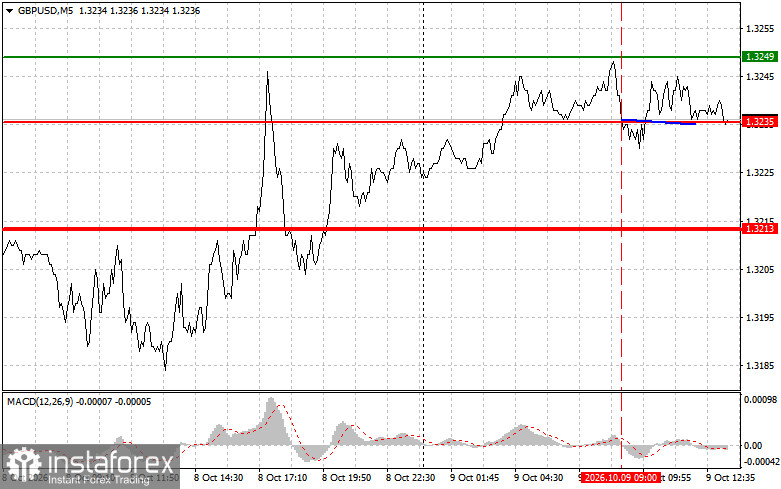
Buy Signal
Scenario No. 1: The plan is to buy the pound today when the price reaches the entry point around 1.3243 (the green line on the chart), targeting a rise to 1.3259 (the thicker green line on the chart). Around 1.3259, the plan is to close long positions and open short positions in the opposite direction, targeting a move of 30–35 points in the opposite direction from that level. The pound is likely to rise today only if US data are significantly weaker than expected. Important! Before buying, make sure that the MACD indicator is above the zero line and has only just begun rising from it.
Scenario No. 2: The pound will also be considered for buying today if the price tests the 1.3233 level twice consecutively while the MACD indicator is in the oversold zone. This would limit the pair's downward potential and trigger an upward market reversal. The pair could rise toward the opposite levels of 1.3243 and 1.3259.
Sell Signal
Scenario No. 1: The plan is to sell the pound today after the price breaks below the 1.3233 level (the red line on the chart), which could trigger a rapid decline in the pair. The sellers' main target will be 1.3213, where the plan is to close short positions and immediately open long positions in the opposite direction, targeting a move of 20–25 points in the opposite direction from that level. Strong selling pressure on the pound could return if US data are strong. Important! Before selling, make sure that the MACD indicator is below the zero line and has only just begun declining from it.
Scenario No. 2: The pound will also be considered for selling today if the price tests the 1.3243 level twice consecutively while the MACD indicator is in the overbought zone. This would limit the pair's upward potential and trigger a downward market reversal. The pair could decline toward the lower levels of 1.3233 and 1.3213.
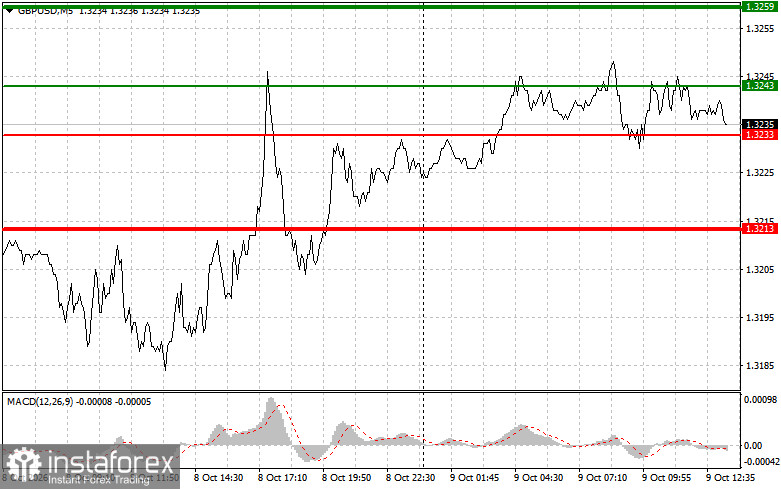
What the Chart Shows
- Thin green line — the entry price at which the trading instrument can be bought.
- Thick green line — the estimated price at which Take Profit can be set or profits can be closed manually, as further gains above this level are considered unlikely.
- Thin red line — the entry price at which the trading instrument can be sold.
- Thick red line — the estimated price at which Take Profit can be set or profits can be closed manually, as further declines below this level are considered unlikely.
- MACD indicator. When entering the market, it is important to consider the overbought and oversold zones.
Important: Beginner Forex traders should exercise extreme caution when making market entry decisions. Before the release of major fundamental reports, it is generally best to stay out of the market to avoid sudden exchange-rate fluctuations. If trading during news releases, always place stop-loss orders to minimize losses. Without stop-loss orders, the entire trading account can be depleted very quickly, especially when risk management rules are ignored and large position sizes are used.
Remember that successful trading requires a clear trading plan, such as the example presented above. Making spontaneous trading decisions based on current market conditions is a losing strategy for an intraday trader from the outset.