 English
 Русский
 Bahasa Indonesia
 Bahasa Malay
 ไทย
ไทย Español
 Deutsch
 Български
 Français
 Tiếng Việt
 中文
中文 বাংলা
বাংলা हिन्दी
 Čeština
 Українська
 Română


As of yesterday, Europe's single currency and the British pound retained upside potential. The pound rose sharply against the dollar already in Asian hours, and the euro showed a significant gain. Recall that the move was triggered by a sharp fall in US bond yields. When bond prices rise, yields fall, and the dollar weakened markedly yesterday even though inflationary pressure was high. The market had already priced that pressure and fairly quickly retraced.

The euro held firm even after another US release. US producer prices for September came in at 1.3% month-on-month and 6.3% year-on-year versus forecasts of 0.5% and a drop to 5.3% y/y. In August, PPI was 0.5% and 5.6% y/y. This was well above economists' expectations and temporarily boosted dollar demand, and you can see a sharp downward move on the chart after the print. Core producer prices also surprised to the upside—0.7% versus 0.3% and 5.0% y/y after 4.8% in August. Retail sales for September rose 0.8% versus a 0.3% forecast. The figure looks decent, but August saw a 1.3% surge, so this is a slowdown relative to that, and traders were more inclined to sell the dollar than buy it. All that allowed the euro and the pound to retain upward potential. In today's Asian trading the pound pushed toward weekly highs, and the euro also strengthened, but it has not yet cleared 1.1241.
Kevin Warsh's remarks also played a notable role. The euro's and pound's gains were timed to the period after his speech. He said he would not provide new forecasts or rate guides, that he remains committed to the strategy he set when taking office, and that inflation is a concern, but the committee will act cautiously for now. Recall that after the US CPI print, Wednesday market odds of an October hike rose sharply. Warsh's remarks largely wiped those odds out, and attention has shifted to a December hike, which markets price—the chart shows about an 80% probability of a step to 4.00–4.25%.
Now to the economic calendar. Today there is a lot of important Eurozone data. The main event will be the final CPI for September, with a forecast of 3.8%, the same as the initial flash estimate. Note that eurozone inflation has been accelerating since June: 2.8% in June, 2.9% in July, 3.2% in August, and 3.8% in September. The flash estimate showed the main contribution came from energy—18.8% y/y versus 14.3% a month earlier. If the final figure is revised above 3.8%, that would provide additional support for the euro because high inflation implies high rates and the need for the ECB to act. The deposit rate is now 2.50%, and the market expects a pause on October 29 and a final hike in December to 2.75%; a strong number would reinforce that scenario.
Besides inflation, today's releases include the eurozone trade balance and Italy's CPI (forecast +0.7%). They are unlikely to move the market much; the focus will be on eurozone inflation. In the afternoon US industrial production for September is due, forecasted to be +0.4% after zero in August, and manufacturing output is also expected to show modest improvement. Good prints there could support the dollar.
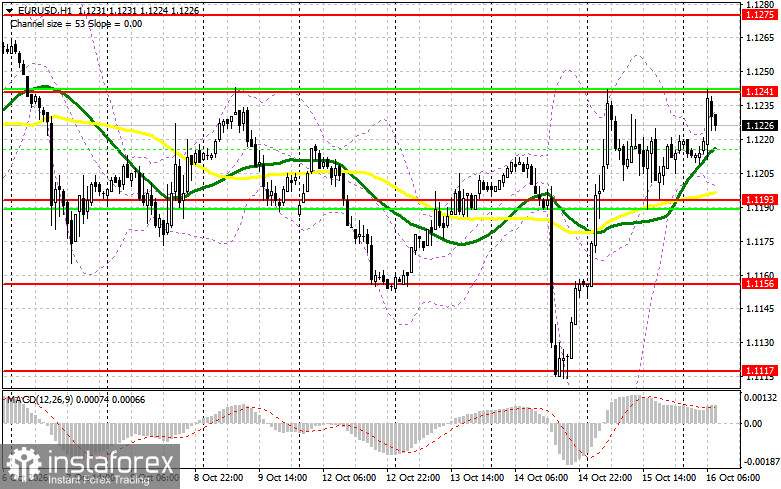
EUR/USD. For shorts the stable level remains 1.1241, but note it was active on October 9 and again yesterday. A false break of 1.1241, formed today in the Asian session, has already worked well for a 15-point downside move, so be careful selling this level again. If eurozone inflation matches forecasts, nothing new will happen, but bears will likely act at 1.1241. If data exceed forecasts, we will probably see a break and close above 1.1241, and then longs toward 1.1275 would be in play. Here I expect renewed bear activity and would only consider selling on false breaks, with a farther target at 1.1310, where I would sell rallies for 25-point moves. If pressure on the euro returns in the first half of the day, I would look to buy—as yesterday—near 1.1193 on a false break or on a false break of 1.1156, also aiming at least for a return to 1.1193. I look to buy bounces from 1.1117 with a 25–30 pip objective.
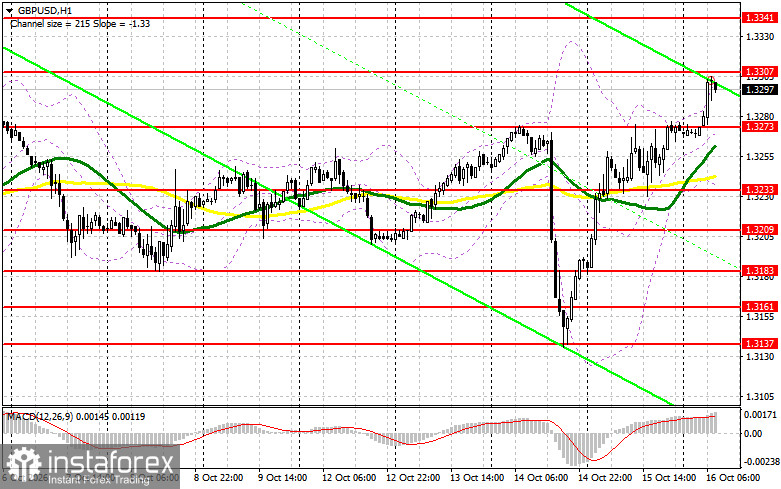
GBP/USD. I expect first active shorts around 1.3307 on a false break, giving a correction to 1.3273. If buyers fail to show, a break and close below will quickly return the pound to the 1.3233 area, where longs are possible on a failed hold. Further bear targets are 1.3209 and 1.3183; from those levels I would buy bounces for 20–25 pips. If the pound's upside continues, a break and close above 1.3307 would open a move to 1.3341, where I would sell on a failed hold or sell a rebound from 1.3368 for 25–30 pips.
What concerns me most today is this: the dollar withstood both strong inflation and the PPI surge and still failed to sustain gains, which means the issue now is where bond yields go. I think while Warsh remains silent on rates and the market looks to December, the euro and pound have enough headroom to stay near weekly highs. But if the eurozone inflation disappoints and US industrials surprise, I would not be surprised if this rebound ends sooner than many expect.