 English

 Русский
 Bahasa Indonesia
 Bahasa Malay
 ไทย
 Español
 Deutsch
 Български
 Français
 Tiếng Việt
 中文
 বাংলা
 हिन्दी
 Čeština
 Українська
 Română



Trade Review and Tips for Trading the Japanese Yen
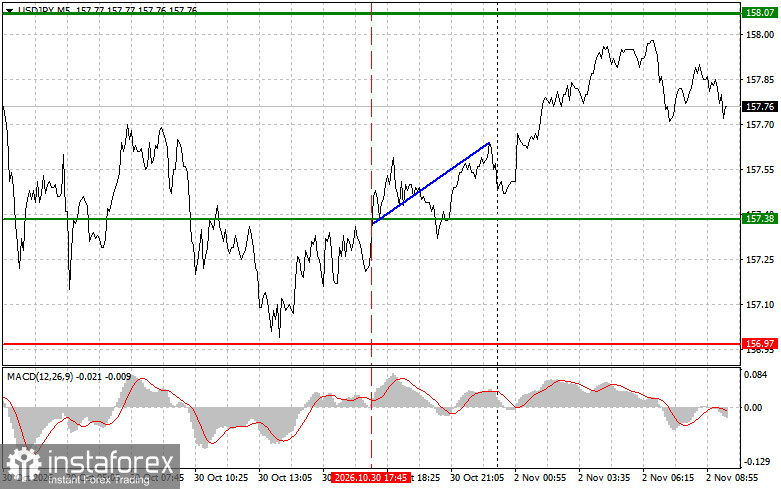
The price test at 157.38 occurred as the MACD indicator began moving up from the zero line, prompting dollar purchases against the yen. However, the rise amounted to only about 20 pips.
Already today demand for the dollar has returned, and the yen began the week by weakening against the U.S. currency. The main trigger was hawkish statements by two Federal Reserve representatives. Alberto Musalem of the St. Louis Fed called for another rate hike in the near term, although as recently as October he spoke of hikes over six to nine months. Tom Barkin of the Richmond Fed added that the policy direction is already clear and the question is only the pace. These words strengthened expectations of another Fed move against the backdrop of core PCE in September at 3.6% versus a 2% target, and the dollar received additional support against the yen.
The yen, however, enters the week with decent backing. On Friday, the Bank of Japan kept the rate at 1.25%, as economists expected. The central bank said core inflation has reached the 2% target for the first time, and at the press conference Kazuo Ueda emphasized the risk of overshooting the target and said anchoring inflation expectations near it remains the main issue. He did not name timing for the next hike, but many traders believe a move could occur as early as December. Today's Japanese manufacturing PMI for October was 53.3 points, exactly matching the forecast and the prior value, so it had almost no effect on the exchange rate. Among fresh news from Japan, the government raised 250 billion yen today, and demand for bonds proved resilient. Stable demand for Japanese bonds shows that domestic investors still willingly buy the country's paper even amid rising global yields. I believe that while the Fed speaks in a hawkish tone, USD/JPY will find support from the dollar, but the BOJ's recognition of achieving the inflation target and the prospect of a December hike will prevent the yen from weakening too quickly.
As for the intraday strategy, I will rely more on scenarios No. 1 and No. 2.
Scenarios to Buy
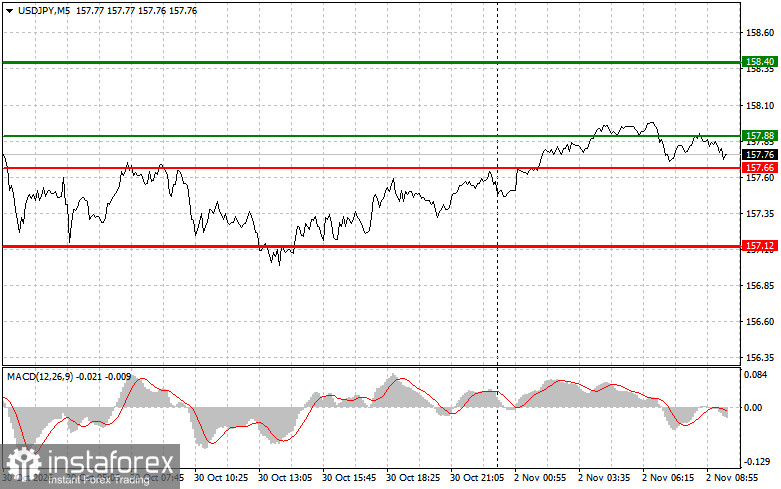
Scenario No. 1: I plan to buy USD/JPY today when the entry point around 157.88 (green line on the chart) is reached, with a target of rising to 158.40 (thicker green line on the chart). Around 158.40, I intend to exit long positions and open short positions in the opposite direction (expecting a 30–35 pip move away from the level). It is best to return to buying the pair on corrections and significant pullbacks of USD/JPY. Important! Before buying, make sure the MACD indicator is above the zero line and is just beginning to rise from it.
Scenario No. 2: I also plan to buy USD/JPY today in the event of two consecutive tests of 157.66 while the MACD indicator is in the oversold area. This will limit the pair's downside potential and lead to an upward reversal. You can expect a rise to the opposite levels of 157.88 and 158.40.
Scenarios to Sell
Scenario No. 1: I plan to sell USD/JPY today only after the 157.66 level is breached (red line on the chart), which will lead to a rapid decline of the pair. The key target for sellers is 157.12, where I plan to exit shorts and immediately open longs in the opposite direction (expecting a 20–25 pip move away from the level). Sellers will return at any moment; only a hint from the central bank is needed. Important! Before selling, make sure the MACD indicator is below the zero line and is just beginning to fall from it.
Scenario No. 2: I also plan to sell USD/JPY today in the event of two consecutive tests of 157.88 while the MACD indicator is in the overbought area. This will limit the pair's upside potential and lead to a downward reversal. You can expect a decline to the opposite levels of 157.66 and 157.12.
What's on the Chart:
Thin green line – the entry price at which you can buy the trading instrument;
Thick green line – the suggested price where you can place a Take Profit or manually lock in gains, since further upside above this level is unlikely;
Thin red line – the entry price at which you can sell the trading instrument;
Thick red line – the suggested price where you can place a Take Profit or manually lock in gains, since further downside below this level is unlikely;
MACD indicator. When entering the market, it is important to follow the overbought and oversold zones.
Important. Beginner Forex traders must be very cautious when making entry decisions. Before the release of important fundamental reports, it is best to stay out of the market to avoid getting caught in sharp price swings. If you decide to trade during news releases, always place stop orders to minimize losses. Without stop orders, you can quickly lose your entire deposit, especially if you don't use money management and trade large volumes.
Remember, successful trading requires a clear trading plan, like the example I presented above. Spontaneous trading decisions based on the current market situation are a losing strategy for an intraday trader from the start.