 English

 Русский
 Bahasa Indonesia
 Bahasa Malay
 ไทย
 Español
 Deutsch
 Български
 Français
 Tiếng Việt
 中文
 বাংলা
 हिन्दी
 Čeština
 Українська
 Română



The euro started the week on a firm note. After reaching a Friday low near 1.1155, EUR/USD gained momentum throughout the morning, climbed above 1.1235 during the first half of the day, and only then lost some momentum, slipping back to 1.1217. The main catalyst was the morning release of eurozone manufacturing data, and the market began buying the euro almost immediately after the figures were published.
The data in question was the eurozone Manufacturing PMI for October. This is a survey of purchasing managers at factories, where a reading above 50 indicates expansion in manufacturing activity, while a reading below 50 signals contraction. The index came in at 52.7, compared with 52.9 in the previous month, representing a slight decline. However, economists had expected an even weaker reading, so the market viewed the report as a positive surprise rather than bad news. In addition, the index has remained above 50 for the ninth consecutive month, while the September reading was the highest since May 2022. For the ECB, the index's individual components may be more important than the headline figure, including whether manufacturers' input costs continue to rise.
Conditions across the eurozone remain uneven. Germany kept its Manufacturing PMI at 54.2, while Italy disappointed with a reading of 49.4, below the forecast of 49.9 and below the key 50 threshold. There was also disappointing news from German retailers. German retail sales fell by 2.0% in September, although analysts had expected a 0.4% increase. This indicator measures the volume of goods purchased in stores, and the sharp decline suggests that consumers in the region's largest economy are cutting back significantly. In other words, manufacturing is holding up relatively well, while consumer demand is weakening. Against this mixed economic backdrop, the euro's advance does not look particularly solid, and the morning pullback from the high is understandable.
Now, regarding the events scheduled for the second half of the day. Bundesbank President Joachim Nagel is due to speak. The Bundesbank is one of the institutions involved in the ECB's interest rate decision-making process. Particular attention will be paid to his assessment of the contrast between stronger manufacturing activity and weak retail sales, as his tone could influence how confident the market is about the continuation of eurozone economic growth.
The main event of the day remains the U.S. economic data. The October ISM Manufacturing PMI is expected to come in at 54.7, compared with 54.5 in September. This is also a purchasing managers' survey, but it covers U.S. businesses. The market pays close attention to it because it provides an early indication of the state of U.S. manufacturing ahead of official reports. Particular attention will be paid to its price component, which indicates how quickly manufacturers' input costs are rising. The forecast is 77.2, compared with the previous reading of 77.9. A high reading would reinforce expectations that the Federal Reserve will not rush to cut interest rates.
The picture will be supplemented by September U.S. construction spending data. An increase of 0.3% is expected, following a 0.9% rise. This indicator is sensitive to mortgage rates, so a significant slowdown would show how heavily high borrowing costs are weighing on the economy. Strong U.S. figures would support the dollar and push EUR/USD lower, while weak data would give the euro an opportunity to return to its daily highs. The primary scenario is a downward move, as the pullback from the high has already begun.
Momentum
For the euro, the key resistance level is 1.1231. If the price consolidates above it, a move toward 1.1254 is possible, followed by 1.1298. The pair already moved above this level during the morning session but failed to reach 1.1245 before retreating. Therefore, any renewed breakout should be confirmed by consolidation above the level rather than treated as valid on the first test.
The downward breakout level is 1.1200. If the price moves decisively below it, the targets are 1.1172 and 1.1138. This is the preferred direction, as the pair is currently moving toward this threshold, and strong U.S. data could accelerate the decline. The distance between the current price of 1.1217 and 1.1200 is small, so beginner traders should wait for the price to consolidate below the level rather than simply touch it.
Mean Reversion
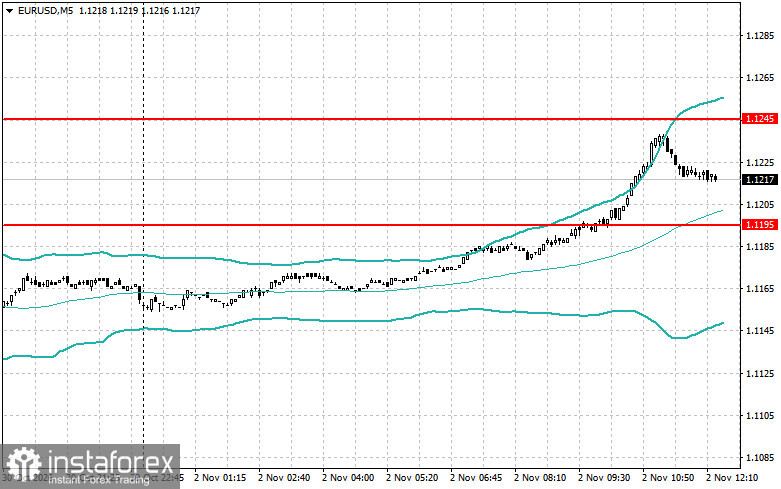
For the euro, the upper reference level for a potential reversal is 1.1245. It lies between the breakout level of 1.1231 and the first target of 1.1254, just nine points below the latter, making this area particularly prone to false signals.
If the price moves up to 1.1245, fails to hold above it, and quickly falls back below, selling opportunities may emerge. However, if the pair moves decisively above 1.1254, this would constitute a confirmed breakout, and trading against it should be avoided. In that case, the stop-loss should be placed above 1.1254.
The lower reference level is 1.1195, located immediately below the 1.1200 breakout level, just five points away. This area requires particular caution. A single test is not enough to determine whether the move represents a genuine breakout or a false break. If the pair reaches 1.1195 and quickly returns above 1.1200, the mean-reversion scenario is playing out, and buying opportunities may be considered. However, if the price consolidates below 1.1200 and continues falling toward 1.1172, buying should be avoided, and a stop-loss should reasonably be placed beyond that target.
The initial reaction in this area is best avoided until the market direction becomes clearer, particularly because U.S. economic data could trigger sharp price movements.