 English

 Русский
 Bahasa Indonesia
 Bahasa Malay
 ไทย
 Español
 Deutsch
 Български
 Français
 Tiếng Việt
 中文
 বাংলা
 हिन्दी
 Čeština
 Українська
 Română



Bitcoin and Ethereum continue to move lower, with the downward trend constantly fueled by new waves of disappointing news. Importantly, virtually all recent developments in the cryptocurrency world have been negative. Central banks, particularly the Federal Reserve, continue to tighten monetary policy. The Clarity Act remains stuck at the legislative stage, while Democrats won the US midterm elections, further reducing the likelihood of the bill being passed. In addition, Bitcoin has historically declined following US midterm elections, which is exactly what we are seeing now. Two weeks ago, the list of negative developments was extended by a hack targeting the world's largest cryptocurrency exchange, Binance.
This was followed by a crash in the US stock market and technology stocks, which many experts closely associate with Bitcoin's price movements. Then came US inflation data, which showed a sharper-than-expected acceleration, further strengthening the market's hawkish expectations regarding the Fed's monetary policy. The icing on the cake was the resignation of Nvidia CEO Jensen Huang, which triggered a massive outflow of capital from technology stocks. The stock market once again dragged the cryptocurrency market lower. As a result, the fundamental backdrop for Bitcoin's growth remains, to put it mildly, questionable.
Meanwhile, Binance founder Changpeng Zhao has identified the reasons behind the latest cryptocurrency market crash. According to Mr. Zhao, investors may have recently been redirecting capital toward Anthropic's upcoming IPO; ETFs have been experiencing capital outflows; the market has faced cybersecurity issues that undermine investor confidence; high US inflation has strengthened hawkish expectations regarding the Fed's monetary policy; rising yields on US Treasury bonds have triggered capital outflows from risk assets; and the results of the US elections have reduced investor optimism about cryptocurrency regulation.
It is very kind of Mr. Zhao to list the reasons AFTER Bitcoin has already fallen, but, for instance, we were pointing them out a month ago. In any case, the decline has already happened, and Bitcoin is once again trading not far from its lows. At this point, Bitcoin's only chance lies in maintaining its sideways movement on the daily timeframe without breaking below the lower band of the range.
Trading recommendations for BTC/USD
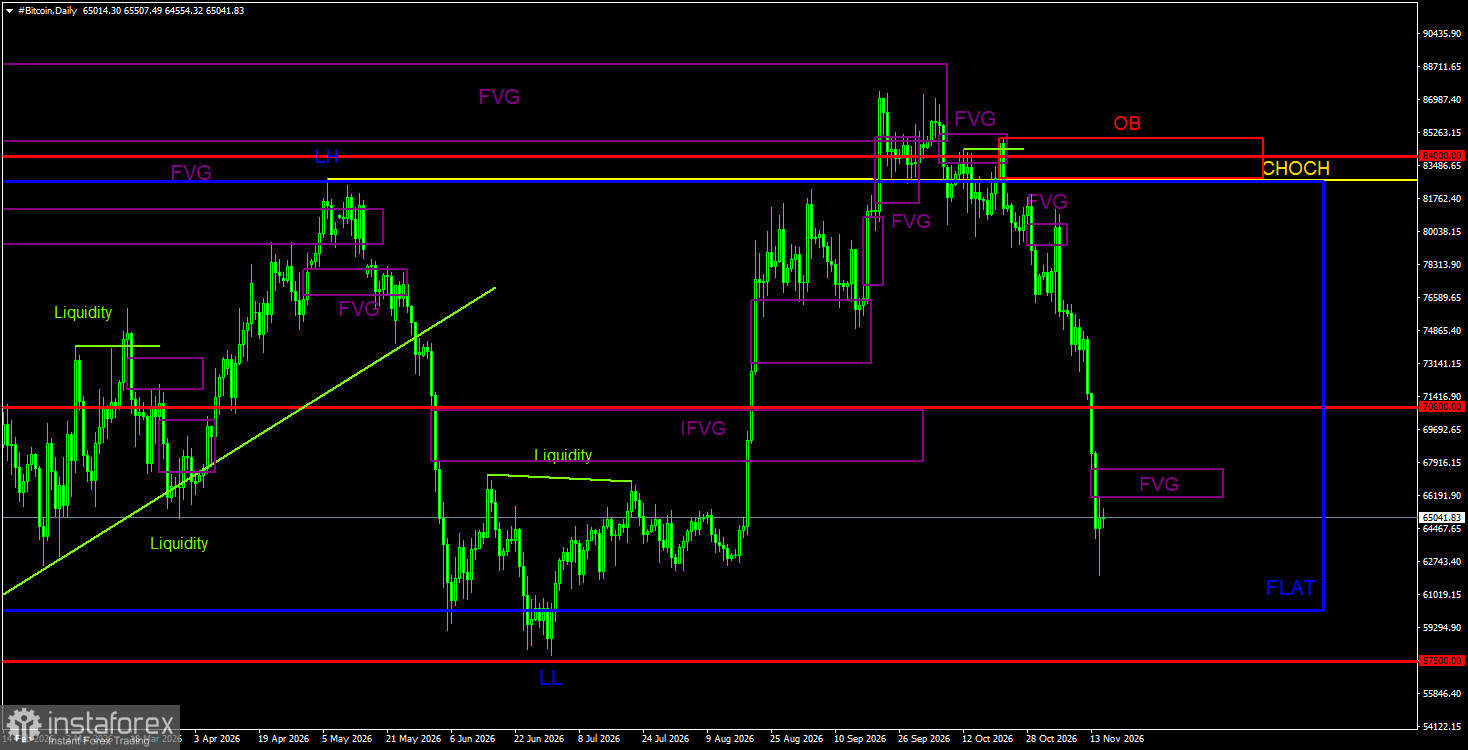
Bitcoin attempted to start a new uptrend, but the fundamental backdrop, spot demand, and latest news proved too negative to support its continuation. In the near term, Bitcoin may continue declining on the daily timeframe, as the price has formed a deviation above the upper boundary of its trading range and reacted to three bearish Fair Value Gaps (FVGs).
Short positions remain relevant in the near term, with targets at $60,200 and $57,500. A new bearish FVG on the daily chart could provide traders with another opportunity to enter the market with short positions.
Trading recommendations for ETH/USD
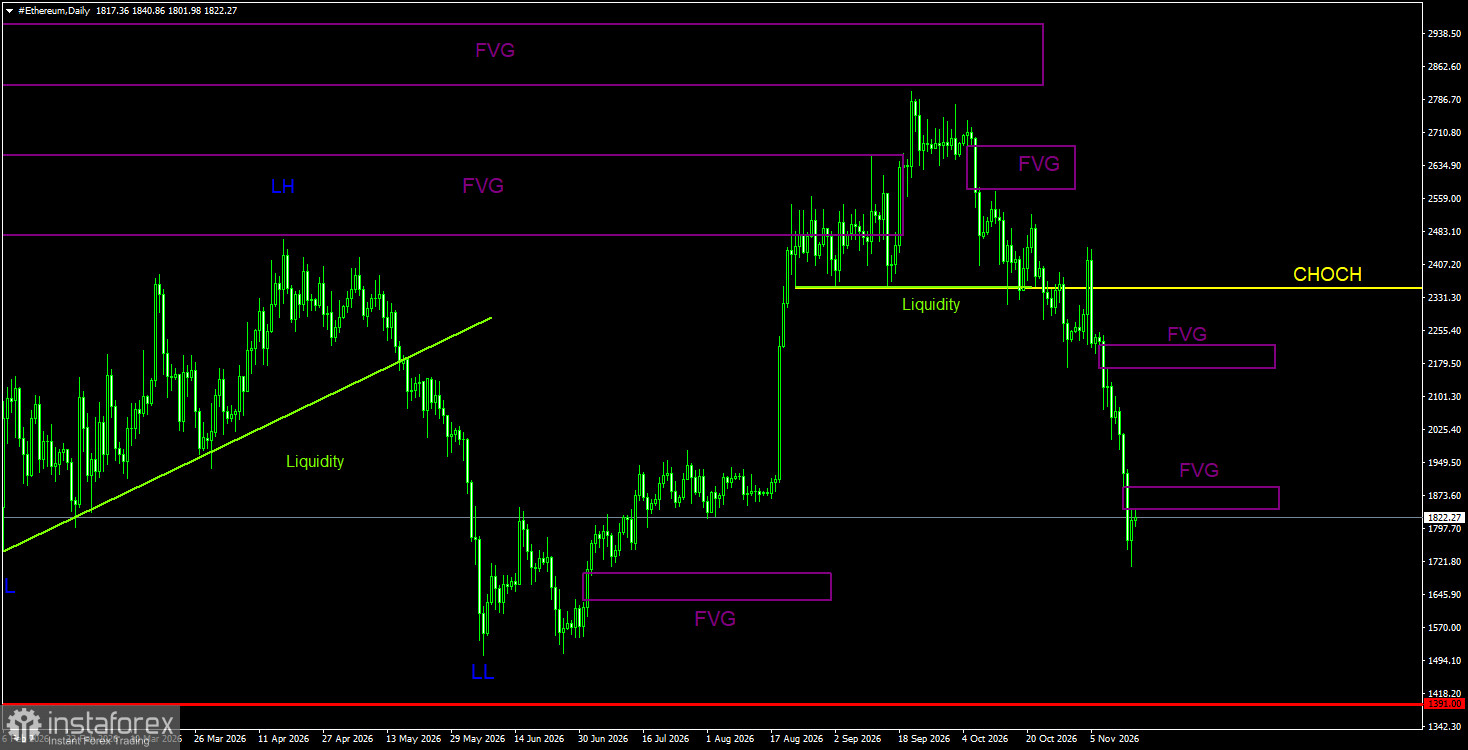
The technical picture for Ethereum has changed on the daily timeframe. Ethereum made a substantial upward move between June and September 2026, which could mark the beginning of a new long-term trend. However, there is still no certainty that Bitcoin's bearish trend has come to an end.
Bitcoin has generated enough sell signals and bearish patterns on the daily chart to account for its decline over recent weeks. Therefore, it is hardly surprising that Ethereum has also suffered a sharp price drop and may continue moving south. The target is located near $1,391.
There are enough bearish FVGs on both the daily and four-hour timeframes to serve as Points of Interest (POIs) for short positions. A potential end to Ethereum's decline can only be anticipated if Bitcoin fails to break below the lower band of its sideways trading channel on the daily chart.
Comments on the charts
CHOCH is a change of character / break of the trend structure. Liquidity means traders' Stop-Losses that market makers use to build their positions. FVG stands for a Fair Value Gap (area of price inefficiency). The price often moves quickly through such areas, indicating the absence of one side in the market. Later, the price tends to return and react to these zones. IFVG is an Inverted Fair Value Gap. After a return to such a zone, the price does not react but impulsively breaks through and then tests it from the other side.
OB means an Order Block. A candle on which a market maker opened a position in order to harvest liquidity and then form their own position in the opposite direction.