 GBP/USD Forecast: Pound Climbs Toward 1.3630 as Softer Wage Growth Weakens Dollar and BoE Support Keeps Sterling Firm
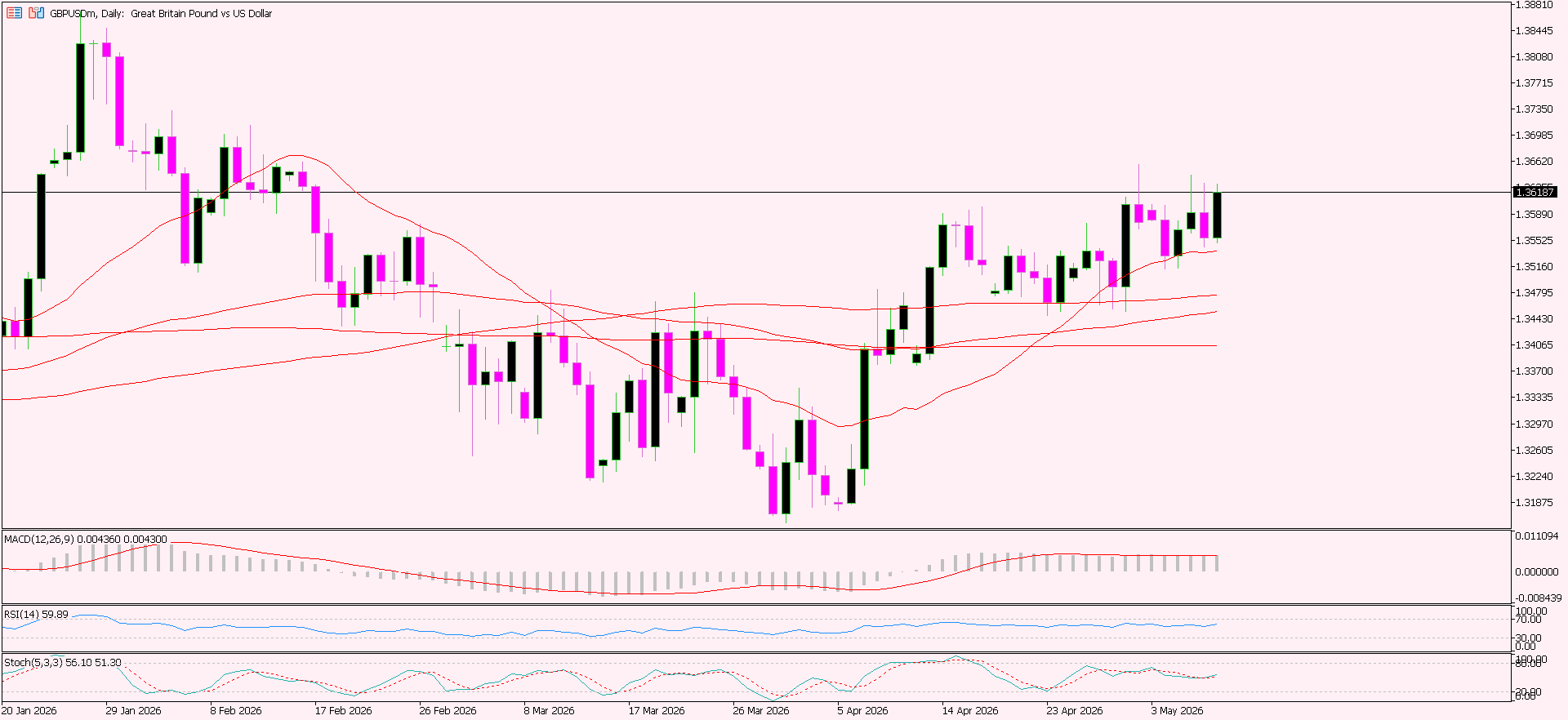
 GBP/USD is pushing higher near the 1.3630 area, and the daily chart shows a market that has quietly rebuilt bullish control after the late-March base around 1.3180. The pair is now testing a familiar resistance zone near 1.3615–1.3630, where previous supply has slowed advances before. This latest move is not only technical; it is being supported by broad US Dollar weakness after the US employment report showed softer wage growth, while the Pound remains steady despite UK political noise from local election results. The chart structure has improved noticeably. GBP/USD is trading above the key moving average cluster, with the shorter-term average rising underneath price and acting as dynamic support. The recovery from the April breakout zone near 1.3400 has formed higher lows, and buyers have continued to defend pullbacks around 1.3470–1.3520. That keeps the broader daily bias constructive. However, the pair is now approaching the 1.3630–1.3660 resistance band, so the next daily close will matter. A clean break above this zone would confirm that buyers are ready to extend the move rather than simply retest old resistance. Momentum supports the bullish case, but it is not yet overheated. RSI is hovering near 60, showing steady upward pressure without entering extreme territory. MACD remains positive and broadly stable, suggesting the recovery trend is still alive even if momentum is not accelerating aggressively. Stochastic is also turning upward from mid-range, which fits the latest bullish candle. In simple terms, the indicators are giving the Pound enough technical backing, but price still needs confirmation above resistance to attract stronger follow-through. Fundamentally, the US jobs report created a mixed but ultimately dollar-negative reaction. NFP beat expectations at 115K, and March was revised higher, showing the labor market is not collapsing. But wage growth slowed to 3.6%, below the 3.8% forecast, and that matters more for inflation expectations. Softer earnings reduce pressure on the Federal Reserve to stay aggressively hawkish, which is why the US Dollar Index slipped toward 97.90 despite resilient headline hiring. For GBP/USD, that creates a cleaner path higher as long as Fed easing expectations remain alive. On the UK side, Sterling has managed to stay stable even with political uncertainty. Labour’s local election losses and Reform UK’s gains could create pressure around Prime Minister Keir Starmer, but markets are not yet treating this as a major fiscal or leadership crisis. More importantly, Bank of England Governor Andrew Bailey’s warning that the BoE could act “forcefully” if Middle East-driven energy inflation persists is giving the Pound a policy cushion. With the BoE holding rates at 3.75% but keeping the door open to tightening, Sterling is not being left unsupported. Overall, GBP/USD has a bullish near-term setup while price holds above 1.3520–1.3470. A sustained break above 1.3630–1.3660 could open the door toward 1.3700 and then 1.3770. On the downside, failure at current resistance may trigger a pullback toward 1.3560 first, followed by the moving-average support area near 1.3520. For now, the chart and fundamentals are working together: softer US wage pressure is weighing on the Dollar, while BoE inflation caution and improving technical structure keep the Pound supported.
*The market analysis posted here is meant to increase your awareness, but not to give instructions to make a trade
 English
 Русский
 Bahasa Indonesia
 Bahasa Malay
 ไทย
ไทย Español
 Deutsch
 Български
 Français
 Tiếng Việt
 中文
中文 বাংলা
বাংলা हिन्दी
 Čeština
 Українська
 Română